Problem-Solving Notes | Backtracking & Recursion
🌐 中文版:繁體中文
Recursion
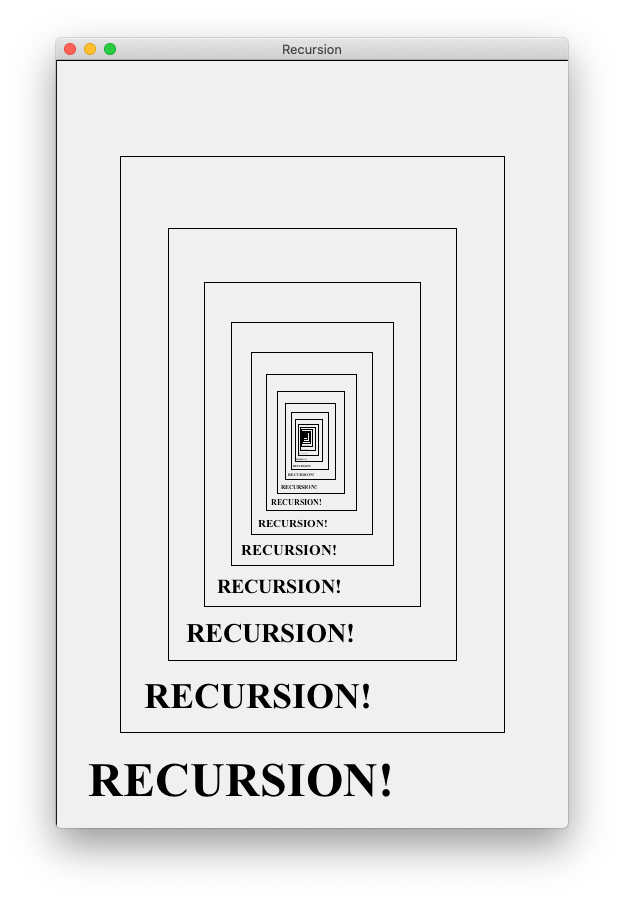
When solving backtracking problems you can usually implement them with recursion, so it’s best to first understand the idea of recursion. The core idea of recursion is “break a big problem into several small problems, and the small problems can be split the same way into even smaller problems” and “except for the smallest problem, every level is solved the same way”.
Tower of Hanoi
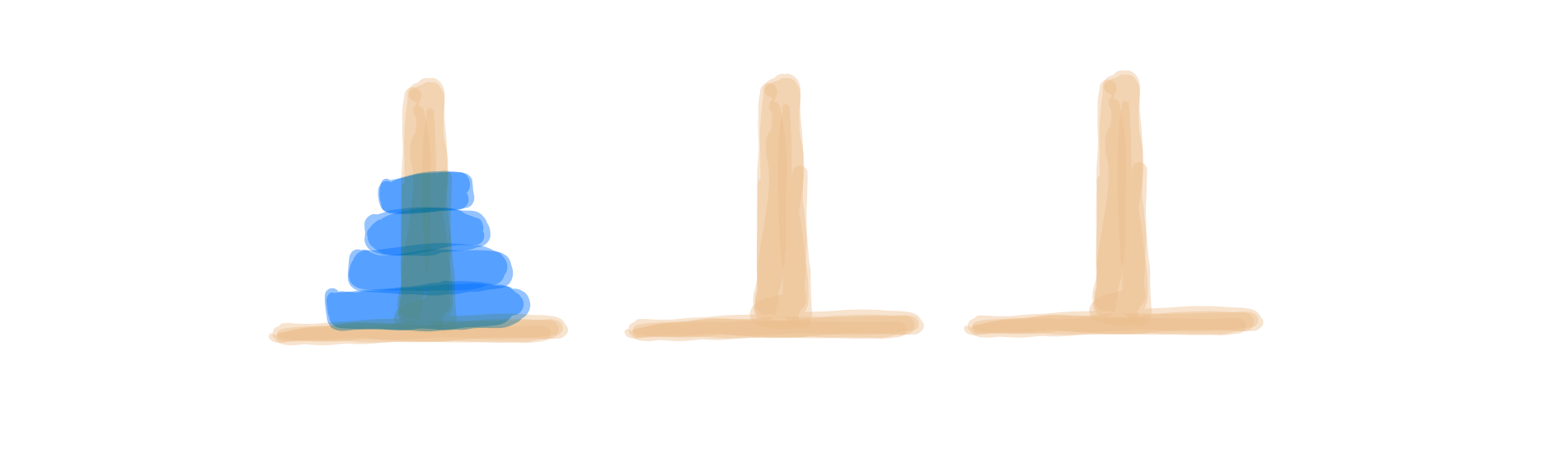
The Tower of Hanoi is the classic recursion problem. The problem is: there are three rods, and N disks stacked on the leftmost rod (N = 4 in the figure above). Now we want to move them all to the rightmost rod. What is the minimum number of moves needed?
- Each move you pick one rod and move its topmost disk; you can only move one at a time
- A larger disk can’t be placed on top of a smaller one
Here we need to follow the recursive mindset, solving a big problem by solving several small problems. The big problem here is how many steps does it take to move four disks to the right? and the small problem is how many steps to move three disks?
The problem is essentially the same, just with a smaller scope. Here, assuming we already know the answer for moving two disks, we can picture the problem like the figure below.
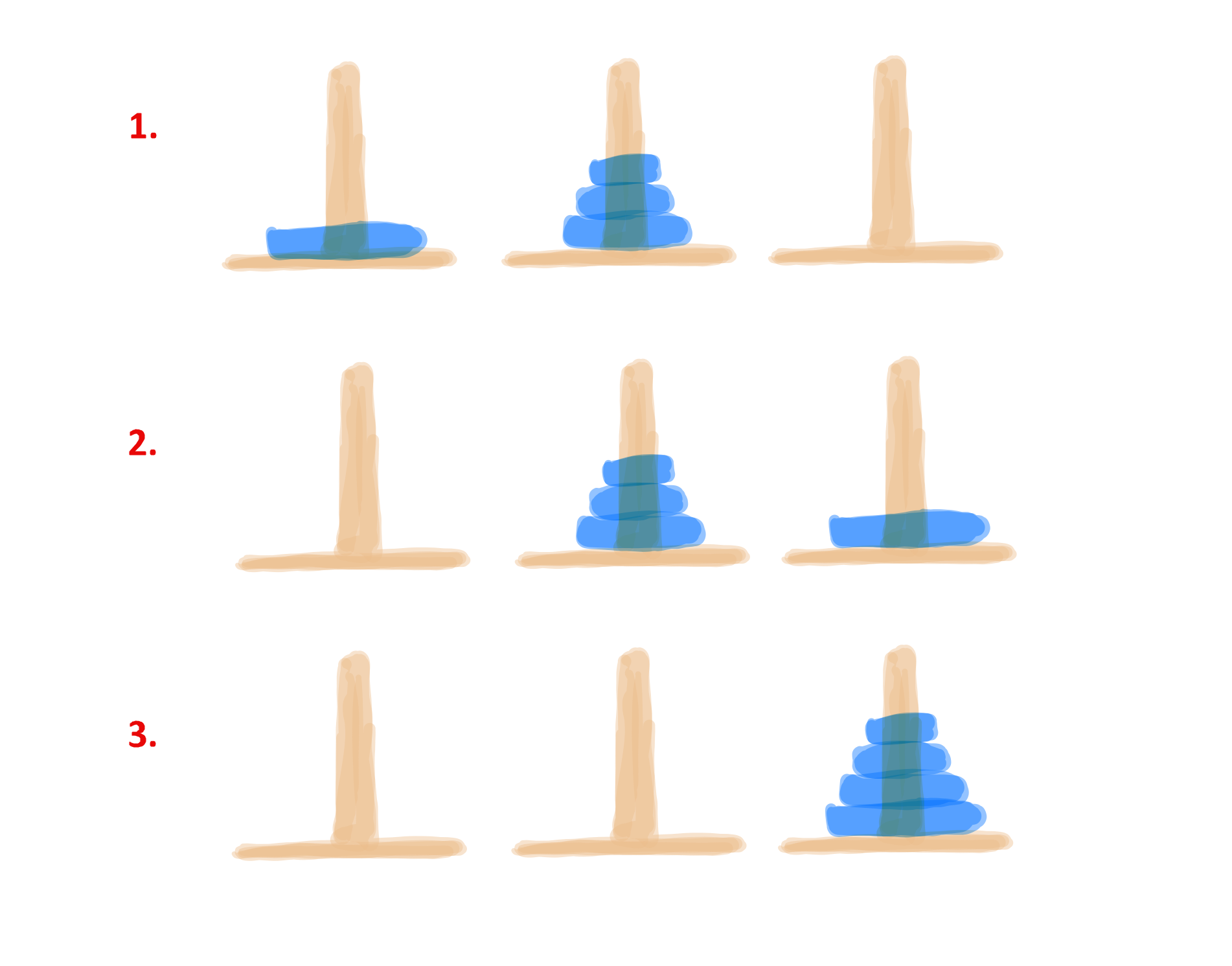
- Move the top three disks from the left to the middle (never mind how for now; the current result is three disks stacked in the middle)
- Move the leftmost disk to the right
- Move the three disks in the middle to the right (never mind how for now; the current result is three disks stacked on the rightmost disk)
Because the problem cares about the number of moves, first assume moving the three disks on the left to the middle takes $K$ steps, moving the remaining one disk to the right takes 1 step, and finally moving the three middle disks to the right takes $K$ steps, so the total is $2*K +1$.
From the relation between the big and small problems we get the relation: $ F(N) = 2*F(N-1)+1$, where $F(N)$ is the number of steps to move $N$ disks. Of course, in implementation we also need to consider the smallest problem, which here is the number of steps to move one disk, which is obviously 1. So we can write the algorithm like this:
1 | int HanoiTower(int n){ |
In summary, when you hit recursion always think about these three points: (1) what are the big and small problems, (2) how to write the relation between the big and small problems, (3) what is the smallest problem?
Introduction to Backtracking
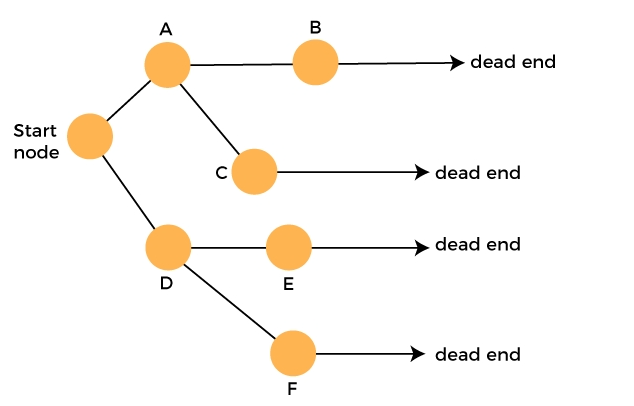
Backtracking is a kind of exhaustive algorithm. Its core idea is “if a path doesn’t work, go back”. That is, when you want to search for some data, if a particular data path doesn’t work out, you step back to the previous step and try another path. So there must be a condition to judge whether a path is the one to take, and if it doesn’t meet the condition, you back off.
Backtracking is usually implemented with recursion.
Core concepts
Enumerate
- List every possible next step
Pruning
- When something doesn’t meet the condition, skip the next step and don’t keep enumerating
- This is actually more advanced; essentially it lets the search end early
Honestly, when solving Tree-related concepts earlier I’d already used the backtracking idea, like DFS: at the start you set a termination condition (e.g. reaching a leaf), then each time you recursively call the next DFS function to visit the next node.
Categories of Backtracking problems
Permutations
A lot of online explanations of the backtracking concept use Permutations as the example. The problem is roughly guessing a password, for example, given 1, 2, 3, how many non-repeating password combinations are there, or arranging symbols to see how many combinations exist. The common idea is to solve with recursion, exhausting all possibilities and backing off wrong answers.
Here we can also view it as different levels. In the figure above, each recursive call goes down one level. At first there’s no number at all, so there’s no value, which you can think of as level 0, and going down one level means starting to explore the possible digits: the first digit of the password could be 1, 2, or 3. Then we again recursively call the next level: for the case where the first digit is 1, the second digit could also be 1, 2, or 3, with the new digit appended after the old one, so we currently have 1,1, 1,2, 1,3; and for the case where the second digit is 2, its next level is 2,1, 2,2, 2,3, and for 3 the next level could be 3,1, 3,2, 3,3. Then we recursively call the next level again. The termination condition of the recursion is reaching the required number of levels, finding the password.
Below is a simple implementation:
1 |
|
The snippet above is the termination condition: once we reach the maximum depth we stop searching further
1 | if(depth == MAX_DEPTH){ |
Below, at each node we try inserting 1, 2, or 3 before advancing to the next level, and if we reach the maximum depth we back off. After backing off one level, we clear the digit that was occupying the last position of password.
1 | for (int i = 0; i < nums.size(); i++) { |
Output:
1 | 1 2 3 |
Subsets
This kind of problem usually gives an integer set with no duplicate numbers and asks you to find all possible subsets
For the integer set [1,2,3], all possible subsets are:
{ [],[1],[2],[3],[1,2],[1,3],[2,3],[1,2,3]}
[1,2]=[2,1][1]=[1,1]
This type of problem can be solved with backtracking, and at each step you can choose whether to include a given element.
1 |
|
Output:
1 | { } |
Its call logic is also a classic tree structure
1 | subsets(nums, 0) |
When we reach a leaf node (index == nums.size()), we’ve made all the decisions at this point and formed a complete subset, which is then output.
Combinations
This is like high-school permutations and combinations: given integers 1 to N, choose K numbers and find all possible combinations.
N=4, K=2
then the output is:{[1,2],[2,3],[3,4],[1,3],[1,4],[2,4]}
The solution to this type of problem is similar to subsets: you need to give a starting index and stop once K numbers are chosen.
1 |
|
Output:
1 | { 1 2 } |
Below, a tree structure illustrates the recursive process of finding the output (N=4, K=2):
From 1 ~ 4
1 | combinations(N=4, K=2, index=0, start=1) |
From 2 ~ 4
1 | combinations(N=4, K=2, index=0, start=2) |
From 3 ~ 4
1 | combinations(N=4, K=2, index=0, start=3) |
Palindrome Partitioning
Cut a string into a group of palindromic substrings, where every substring is a palindrome, and list all the ways to cut it
1 |
|
Here we take the string aab as an example
1 | [""] # 'aab' |
- First the returned vector is empty, then comes the first level
- The first level cuts starting from
a, treating it as the first palindromic substring, then recursively handles the remainingab - Besides cutting out just
a, we can also cutaaand treat it as a palindrome, then handle the remainingb - Then comes the second level: after choosing
a, we cut anotherafrom the remaininga, then handle the remaining stringb - If we chose
aa, onlybis left to handle - Third level: when we reach
b, sincebitself is a palindrome, it can be a single cut.
First path:
["a", "a", "b"], cut as"a" → "a" → "b"
Second path:["aa", "b"], cut as"aa" → "b"
When to use Backtracking
Because the amount of computation is huge, it’s usually used for cases where you need to find all solutions, but the downside is also the huge amount of computation, which can further increase time complexity. You can usually use the pruning mentioned earlier to reduce the number of searches.
Backtracking-related LeetCode problems
Medium
- 17. Letter Combinations of a Phone Number
- 77. Combinations
- 46. Permutations
- 39. Combination Sum
- 22. Generate Parentheses
- 79. Word Search
- 688. Knight Probability in Chessboard
Hard
Reference
[1] https://www.secondlife.tw/algorithms-backtracking/
[2] https://web.ntnu.edu.tw/~algo/Backtracking.html
[3] https://medium.com/@ralph-tech/%E6%BC%94%E7%AE%97%E6%B3%95%E5%AD%B8%E7%BF%92%E7%AD%86%E8%A8%98-%E5%9B%9E%E6%BA%AF%E6%B3%95-backtracking-%E5%88%86%E6%94%AF%E5%AE%9A%E7%95%8C%E6%B3%95-branch-and-bound-29165391c377
[4] https://wiki.csie.ncku.edu.tw/acm/course/Backtracking
[5] https://www.javatpoint.com/backtracking-introduction
[6] https://willrosenbaum.com/teaching/2021s-cosc-112/notes/recursive-image/
[7] https://www.javatpoint.com/backtracking-introduction
[8] https://ithelp.ithome.com.tw/articles/10273084?ref=secondlife.tw




If you find my articles helpful, please support Kevin!
 Use boba to safe Kevin!