🌐 中文版:繁體中文

What is a Queue?

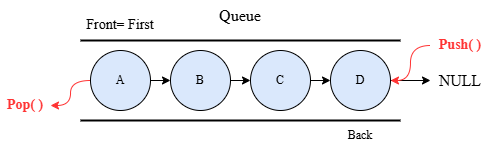
A Queue is also a data structure used to temporarily store elements. Unlike a Stack, it has the FIFO (First-In-First-Out) property, meaning the element that enters the queue first comes out first, and new elements are added to the tail of the queue.

Queues are usually used in systems that need ordering consistency, like network packet processing, OS process scheduling, BFS, and so on. Think of it like waiting in line to buy tickets.

Queue operations:

  • Front of the line: front
  • Back of the line: back
  • Enter the line: push, can only enter from the back
  • Leave the line: pop, can only leave from the front
  • Push(data): put data into the queue from the back and update it to the new back; adding data to the queue is also called enqueue
  • Pop: remove the data pointed to by front from the queue and update front; removing data from the queue is also called dequeue
  • getFront: return the data pointed to by front
  • getBack: return the data pointed to by back
  • IsEmpty: check whether the queue has any data
  • getSize: return the number of data items in the queue

Queue implementation (C++)

Implementing a Queue with a Linked List

  • The queue’s front is the first node of the linked list, and back is the last node of the list
  • But since a queue needs getFront and getBack, besides a pointer tracking the front node we also need a pointer tracking the back node

Code

1
2
3
4
5
6
7
8
9
10
11
12
13
14
15
16
17
18
19
20
21
22
23
24
25
26
27
28
29
30
31
32
33
34
35
36
37
38
39
40
41
42
43
44
45
46
47
48
49
50
51
52
53
54
55
56
57
58
59
60
61
62
63
64
65
66
67
68
69
70
71
72
73
74
75
76
77
78
79
80
81
82
83
84
85
86
87
88
89
90
91
92
93
94
95
96
97
98
99
100
101
102
103
104
105
106
107
108
109
110
111
112
113
114
115
116
117
118
119
120
121
122
123
124
#include <iostream>
using namespace std;

struct QueueNode {
int data;
QueueNode *next;
QueueNode(): data(0), next(0){};
QueueNode(int x):data(x), next(0){};

};

class QueueList{
private:
QueueNode *front;
QueueNode *back;
int size;
public:
QueueList(): front(0), back(0), size(0){};
void Push(int x);
void Pop();
int getFront();
int getBack();
int getSize();
bool IsEmpty();
};


void QueueList::Push(int x){
if(IsEmpty()){
front = new QueueNode(x);
back = front;
size++;
return;
}
QueueNode *newNode = new QueueNode(x);
back->next = newNode;
back = newNode;
size++;
}

void QueueList::Pop(){
if (IsEmpty()){
cout << "empty queue" << endl;
return;
}
else{
QueueNode *tempNode = front;
front = front->next;
delete tempNode;
tempNode = 0;
size--;
}
}

int QueueList::getFront(){
if(IsEmpty()){
cout << "empty queue" << endl;
return -1;
}
else{
return front->data;
}
}

int QueueList::getBack(){
if(IsEmpty()){
cout << "empty queue" << endl;
return -1;
}
else{
return back->data;
}
}

int QueueList::getSize(){
return size;
}

bool QueueList::IsEmpty(){
if(size == 0) return true;
else return false;
}

int main(){

QueueList q;
if(q.IsEmpty()){
cout << "empty queue" << endl;
}

q.Push(24);
cout<< "After push 24: \n";
cout << "front: " << q.getFront() << " back: " << q.getBack() << "\n";
q.Push(8);
cout<< "After push 8: \n";
cout << "front: " << q.getFront() << " back: " << q.getBack() << "\n";
q.Push(23);
cout<< "After push 23: \n";
cout << "front: " << q.getFront() << " back: " << q.getBack() << "\n";
q.Push(13);
cout<< "After push 13: \n";
cout << "front: " << q.getFront() << " back: " << q.getBack() << "\n";
q.Pop();
cout<< "After pop the front element: \n";
cout << "front: " << q.getFront() << " back: " << q.getBack() << "\n";
q.Push(35);
cout<< "After push 35: \n";
cout << "front: " << q.getFront() << " back: " << q.getBack() << "\n";
q.Pop();
cout<< "After pop the front element: \n";
cout << "front: " << q.getFront() << " back: " << q.getBack() << "\n";
q.Pop();
cout<< "After pop the front element: \n";
cout << "front: " << q.getFront() << " back: " << q.getBack() << "\n";
q.Pop();
std::cout<< "After pop the front element: \n";
std::cout << "front: " << q.getFront() << " back: " << q.getBack() << "\n";
q.Pop();
cout<< "After pop the front element: \n";
q.Pop();

return 0;
}

Output

1
2
3
4
5
6
7
8
9
10
11
12
13
14
15
empty queue
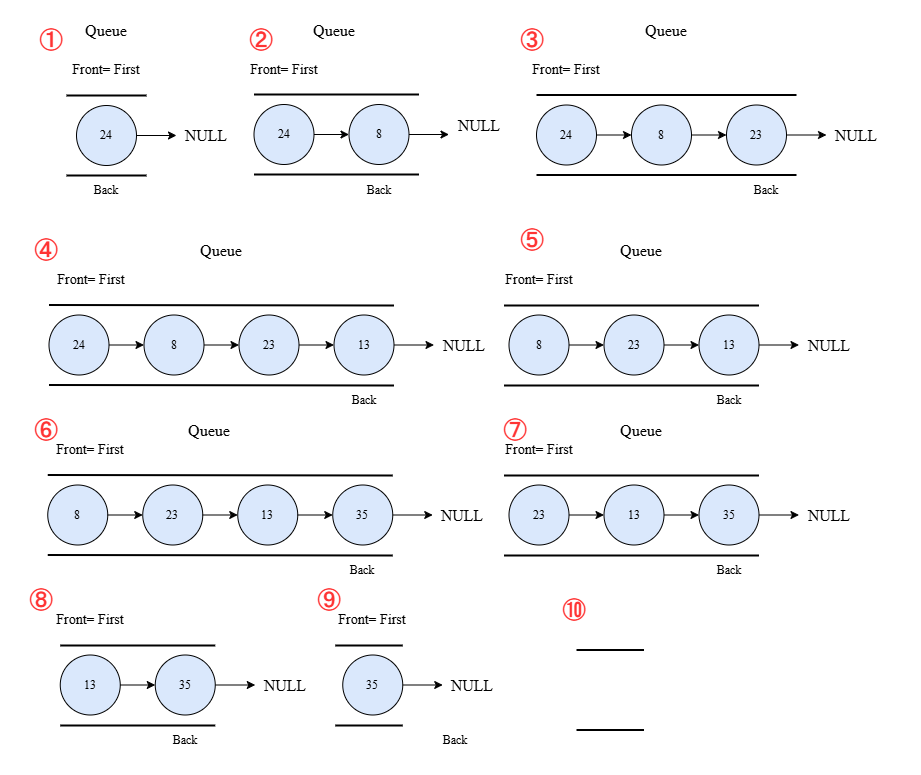
After push 24: //1
front: 24 back: 24
After push 8: //2
front: 24 back: 8
After push 23: //3
front: 24 back: 23
After push 13: //4
front: 24 back: 13
After pop the front element: //5
After push 35: front: 8 back: 35 //6
After pop the front element: front: 23 back: 35 //7
After pop the front element: front: 13 back: 35 //8
After pop the front element: front: 35 back: 35 //9
After pop the front element: Queue is empty. //10

Implementing a Queue with a List

Code

1
2
3
4
5
6
7
8
9
10
11
12
13
14
15
16
17
18
19
20
21
22
23
24
25
26
27
28
29
30
31
32
33
34
35
36
37
38
39
40
41
42
43
44
45
46
47
48
49
50
51
52
53
54
55
56
57
58
59
60
61
62
63
64
65
66
67
68
69
70
71
72
73
74
75
76
77
78
79
80
81
82
83
84
85
86
87
88
89
90
#include <iostream>
#include <vector>

using namespace std;

class QueueList{
private:
int front, back;
vector<int> queue;
public:
QueueList():front(NULL), back(NULL), queue(NULL){}
void Push(int x);
void Pop();
int getFront();
int getBack();
int getSize();
bool IsEmpty();
};

void QueueList::Push(int x) {
queue.push_back(x);
return;
}

void QueueList::Pop(){
if(queue.empty()){
cout << "empty queue" << endl;
return;
}
else{
queue.erase(queue.begin());
return;
}
}

int QueueList::getFront(){
if(queue.empty()){
cout << "empty queue" << endl;
return -1;
}
else{
vector<int>::iterator it=queue.begin();
return *it;
}
}

int QueueList::getBack(){
if(queue.empty()){
cout << "empty queue" << endl;
return -1;
}
else{
vector<int>::iterator it=queue.end()-1;
return *it;
}

}

int QueueList::getSize(){
return queue.size();
}

bool QueueList::IsEmpty(){
if(queue.empty()){
return true;
}
else{ return false; }
}


int main(){

QueueList q;
q.Push(25);
cout << "After Pushing 25: " << "front:" << q.getFront() << " back:" << q.getBack() << endl;
q.Push(50);
cout << "After Pushing 50: " << "front:" << q.getFront() << " back:" << q.getBack() << endl;
q.Push(77);
cout << "After Pushing 77: " << "front:" << q.getFront() << " back:" << q.getBack() << endl;
q.Pop();
cout << "After Poping the front element: " << "front:" << q.getFront() << " back:" << q.getBack() << endl;
q.Pop();
cout << "After Poping the front element: " << "front:" << q.getFront() << " back:" << q.getBack() << endl;
q.Pop();
cout << "After Poping the front element: " << "front:" << q.getFront() << " back:" << q.getBack() << endl;
q.Pop();
cout << "After Poping the front element: " << "front:" << q.getFront() << " back:" << q.getBack() << endl;

return 0;
}

Output

1
2
3
4
5
6
7
8
After Pushing 25: front:25 back:25
After Pushing 50: front:25 back:50
After Pushing 77: front:25 back:77
After Poping the front element: front:50 back:77
After Poping the front element: front:77 back:77
empty queue
empty queue
After Poping the front element: front:-1 back:-1

Queue-related STL

C++ also has a ready-made STL for queue. Before using it you need to declare <queue>. Below are the common member functions:

1
2
3
4
5
6
7
8
9
10
11
12
13
14
15
16
17
18
19
20
21
22
23
24
25
26
27
28
29
30
31
32
33
34
35
# include <iostream>
# include <queue>

using namespace std;


int main(){
queue<int> q;
q.push(1);
q.push(2);
q.push(3);

cout << q.front() << endl;
cout << q.back() << endl;
cout << q.size() << endl;

// copy the queue
int a = q.front();
int &b = q.front();

cout << q.front() << " " << &q.front() << endl; // print the memory
cout << a << " " << &a << endl;
cout << b << " " << &b << endl; // same as memory addr of q.front()

// print the queue contents
int size = q.size();
for (int i = 0; i < size; i++) {
cout << q.front() << " ";
q.pop();
}
cout << "\n";

return 0;
}

Output

1
2
3
4
5
6
7
1
3
3
1 0x76fc70
1 0x7ffc0ddca00c
1 0x76fc70
1 2 3

For the STL of various data structures you can refer to this post I put together.

Time complexity of Queue operations

Both insertion and deletion are $O(1)$, while searching and accessing are both $O(N)$.

Queue-related LeetCode problems

Easy

Medium

Hard

References

[1] https://ithelp.ithome.com.tw/articles/10326158
[2] https://alrightchiu.github.io/SecondRound/queue-introjian-jie-bing-yi-linked-listshi-zuo.html
[3] https://alrightchiu.github.io/SecondRound/queue-yi-arrayshi-zuo-queue.html