
🌐 中文版:繁體中文

Basic introduction

A hash table is a Key-Value mapping structure used for fast data lookup. Compared to the $O(\log n)$ time complexity of general search algorithms, its time complexity is $O(1)$.

The main reason for the lightning speed is the hash function. If we first store n numbers in a hash table, then to check whether a number A is already in the hash table, we just throw A into the hash function and immediately know which slot in the hash table A maps to.

When a Hash Table is not suitable

Conditions where a Hash Table is suitable

  • The problem requires an $O(1)$ time-complexity algorithm to access elements
  • The worst case is also $O(n)$ time complexity

Hash Function

For a hash function to hold, there are three conditions

  1. The value computed by the hash function is a non-negative integer
  2. If key1 = key2, then hash(key1) = hash(key2)
  3. If key1 ≠ key2, then hash(key1) ≠ hash(key2)

A point to note is that putting multiple pieces of data in the same slot easily causes a collision, and the load factor is the factor used to measure how likely a collision is to happen.
- $load factor = n / m$
- $n$ = number of input data items
- $m$ = size of the hash table
- If $load factor > 1$, a collision is very likely
- https://zh.wikipedia.org/wiki/鴿巢原理
- In plain terms: if n > m, then some data must share a bucket with other data

Implementing the hash function (division, stored with an array)

First we can define each data item’s index in the hash table

1
index = key % m        // 0 <= index < m 

Example:

1
2
3
4
5
6
7
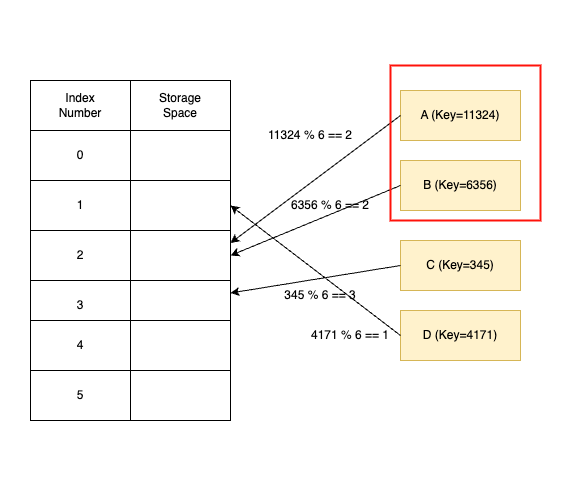
A ( Key = 11324)

B ( Key = 6356)

C ( Key = 345)

D ( key = 4171 )

M (hash table size) = 6, so the hash table’s indices are as follows:

1
2
3
4
5
6
7
Index of A :  11324 % 6 = 2

Index of B: 6356 % 6 = 2

Index of C: 345 % 6 = 3

Index of D: 4171 % 6 =1

You can see that A and B collide, which is related to the choice of m. The choice of m should be as far as possible from $2^p$.
Implementing the hash function (multiplication, stored with an array)

$index = [ m \cdot ((key \cdot A) \mod 1) ]$

$0 ≤ index < (m-1)$

Steps:

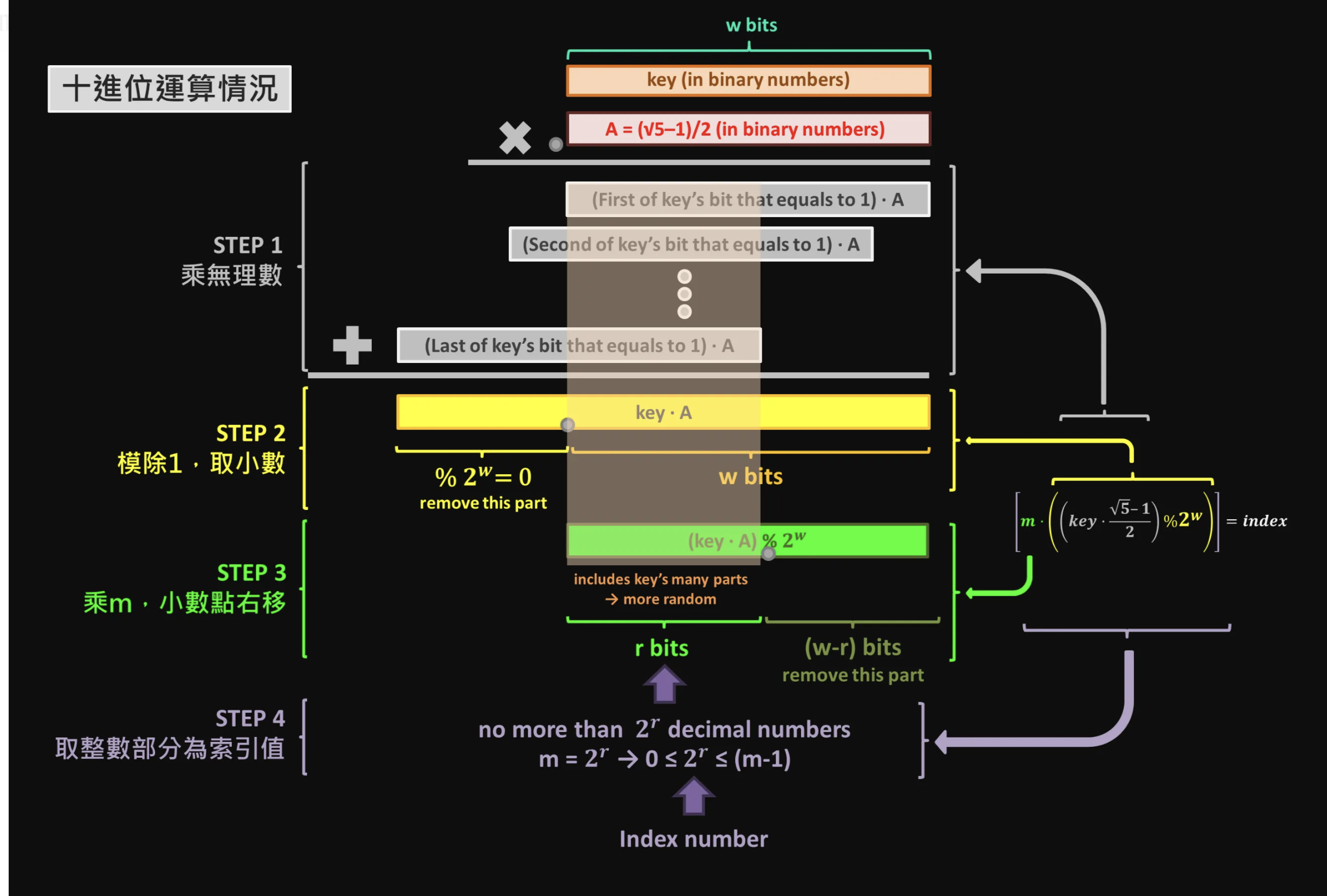
  • Multiply the key by an irrational number less than 1, i.e. A, where A is usually chosen as $\frac{\sqrt5 -1}{2}$; after multiplying you get a larger irrational number
  • Take this irrational number mod 1, which removes the integer part and leaves only the decimal
  • Multiply m by the decimal; this step gives an irrational number between $0$ and $(m-1)$
  • Use the floor function to take the integer of the irrational number

The figure below explains it quite well
Image source: https://medium.com/@ralph-tech/%E8%B3%87%E6%96%99%E7%B5%90%E6%A7%8B%E5%AD%B8%E7%BF%92%E7%AD%86%E8%A8%98-%E9%9B%9C%E6%B9%8A%E8%A1%A8-hash-table-15f490f8ede6
What are the advantages of this more elaborate way of computing the index:

  • No constraint that m must be far from $2^p$
  • Can increase randomness

How to handle addressing collisions?

1. Separate Chaining / Closed Addressing

Generate a new chained storage space within each storage slot, which can be implemented with a linked list or an array
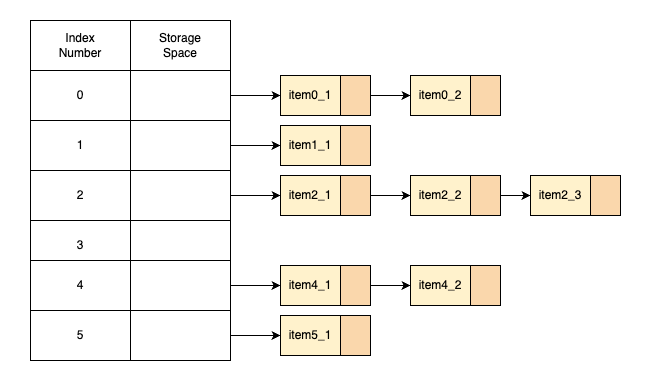
Since extra pointers are needed, if the stored data is smaller than a pointer, using a linked list consumes double the memory to store the data. However, if the data to be stored is much larger than the size of a pointer, the extra cost of the pointer becomes negligible. In fact, we can modify the linked list to combine its back end with data structures like a red-black tree or a skip list, so that the final hash table’s lookup time only needs $O(\log n)$.

This structure is suitable for storing large amounts of data where each item is relatively large, and it also supports more varied optimization strategies, usable in combination with a red-black tree, etc.

2. Open Addressing

Open addressing mainly uses probing to find unoccupied space, which can be divided into:

  • Linear Probing
  • Quadratic probing

Linear Probing

When a collision occurs, check whether the next index position is free; if it’s empty, put the data in, if not, keep looking downward. When searching for an element, if a collision occurs, you also need to search backward, not stopping until you find an empty slot.

Downside: a hash table supports deletion, but a deleted element needs to be marked, otherwise deleting it directly would interrupt subsequent search processes.

Quadratic probing

This can be used to solve the inefficiency of linear probing. When many elements are inserted, linear probing is also slow during addressing.

1
hash(key)+1, hash(key)+2, hash(key)+3,…..hash(key)+n

So with quadratic probing the addressing is changed to:

1
hash(key)+ 1^2 , hash(key)+ 2^2, hash(key)+3^2

Each time it increases by n^2 to find a free slot

Double hashing

Alternatively, if a collision occurs, you can directly run another hash function, i.e. when a collision happens, keep hashing until the collision ends

$index_{n} = F_{1}(k) + (n-1)* F_{2}(k)$ until the final index is found

Pros and cons of open addressing:

Pros:

The open addressing method doesn’t use linked lists; all data is stored in an array, which helps speed up access through caching.

Cons:

Deleting data is more troublesome, requiring special marking of the data to be deleted.
All data is stored in the same hash table, so the cost of a collision is higher, which means the load factor shouldn’t be too high, making this method more wasteful of memory.

Hash Table implementation

1
2
3
4
5
6
7
8
9
10
11
12
13
14
15
16
17
18
19
20
21
22
23
24
25
26
27
28
29
30
31
32
33
34
35
36
37
38
39
40
41
42
43
44
45
46
47
48
49
50
51
52
53
54
55
56
57
58
59
60
61
62
63
64
65
66
67
68
69
70
71
72
73
74
75
76
77
78
79
80
81
82
83
84
85
86
87
88
89
90
91
92
93
94
95
96
97
98
99
100
101
102
103
104
105
106
107
108
109
110
#include <stdio.h>
#include <string.h>
// in order to use bool function in C
#include <stdbool.h>
#define MAX_NAME 256
#define TABLE_SIZE 10

typedef struct{
char name[MAX_NAME];
int age;
}person;


person *hash_table[TABLE_SIZE];

unsigned int hash(char *name);
void init_hash_table();
void print_table();
bool hash_table_insert(person *p);
bool hash_table_delete(person *p);


int main(){
init_hash_table();

person Walt={.name="Walt",.age=26};
person Skyler={.name="Skyler",.age=27};
person Saul={.name="Saul",.age=28};
person Mike={.name="Mike",.age=29};
person Hank={.name="Hank",.age=30};
person Mary={.name="Mary",.age=31};

//add person into hash_table
hash_table_insert(&Walt);
hash_table_insert(&Skyler);
hash_table_insert(&Saul);
hash_table_insert(&Mike);
hash_table_insert(&Hank);
hash_table_insert(&Mary);

print_table();

//delete persion in hash table
hash_table_delete(&Walt);
print_table();

return 0;
}


//define the hash function
unsigned int hash(char *name){
int length=strnlen(name, MAX_NAME);
unsigned int hash_value=0;
for(int i=0;i<length;i++){
hash_value+=name[i];
hash_value=(hash_value*name[i])%TABLE_SIZE;
}
return hash_value;
}

//initialize the hash table to NULL (let it be empty)
void init_hash_table(){
for(int i=0;i<TABLE_SIZE;i++){
hash_table[i]=NULL;
}
}

//print out the hash table
void print_table(){
printf("--------Start--------\n");
for(int i=0;i<TABLE_SIZE;i++){
//nothing in the hash table
if(hash_table[i]==NULL) printf("\t%d\t---\n",i);
//something in the hash table
else printf("\t%d\t%s\n",i,hash_table[i]->name);
}
printf("--------End----------\n");
}

//insert the element into the hash_table
bool hash_table_insert(person *p){
//make sure not call this function with null ptr
if(p==NULL) return false;

//insert the person into the index return by hash_function
int index=hash(p->name);
//check the pointer at that index in the table is null or not
if(hash_table[index]!=NULL) return false; //collision, somebody had occupied there already

//if no one occupied there, then occupied the address
hash_table[index]=p;
return true;
}


bool hash_table_delete(person *p){

// to avoid null ptr
if(p==NULL) return false;

//get index
int index=hash(p->name);

if(hash_table[index]!=NULL){
hash_table[index] = NULL;
}

return true;
}

Using the C++ STL makes problem solving much more convenient:

1
2
3
4
5
6
7
8
9
10
11
12
13
14
15
16
17
18
19
20
21
22
23
24
25
26
27
28
29
30
31
32
33
34
35
36
37
38
39
40
41
42
43
44
45
46
47
48
49
50
51
52
53
54
55
56
57
58
59
60
61
62
63
64
65
66
#include <iostream>
#include <unordered_map>
#include <string>

using namespace std;

struct Person {
string name;
int age;
};

unordered_map<string, Person> hash_table;

void init_hash_table();
void print_table();
bool hash_table_insert(const Person& p);
bool hash_table_delete(const string& name);

int main() {
init_hash_table();

Person Walt = {.name = "Walt", .age = 26};
Person Skyler = {.name = "Skyler", .age = 27};
Person Saul = {.name = "Saul", .age = 28};
Person Mike = {.name = "Mike", .age = 29};
Person Hank = {.name = "Hank", .age = 30};
Person Mary = {.name = "Mary", .age = 31};

// Add persons into hash_table
hash_table_insert(Walt);
hash_table_insert(Skyler);
hash_table_insert(Saul);
hash_table_insert(Mike);
hash_table_insert(Hank);
hash_table_insert(Mary);

print_table();

// Delete person from hash table
hash_table_delete("Walt");
print_table();

return 0;
}

void init_hash_table() {
hash_table.clear();
}

void print_table() {
cout << "--------Start--------" << endl;
for (const auto& pair : hash_table) {
cout << "\t" << pair.first << "\t" << pair.second.name << endl;
}
cout << "--------End----------" << endl;
}

bool hash_table_insert(const Person& p) {
auto result = hash_table.insert({p.name, p});
return result.second; // True if insertion took place, false if key already existed
}

bool hash_table_delete(const string& name) {
return hash_table.erase(name) > 0; // True if element was removed, false if key didn't exist
}

Adding collision handling

1
2
3
4
5
6
7
8
9
10
11
12
13
14
15
16
17
18
19
20
21
22
23
24
25
26
27
28
29
30
31
32
33
34
35
36
37
38
39
40
41
42
43
44
45
46
47
48
49
50
51
52
53
54
55
56
57
58
59
60
61
62
63
64
65
66
67
68
69
70
71
72
73
74
75
76
77
78
79
80
81
82
83
84
85
86
87
88
89
90
91
92
93
94
95
96
97
98
99
100
101
102
103
104
105
106
107
108
109
110
111
112
113
114
115
116
117
118
119
120
121
122
123
124
125
126
127
128
129
130
#include <stdio.h>
#include <stdlib.h>
#include <string.h>
#include <stdbool.h>

#define MAX_NAME 256
#define TABLE_SIZE 10

typedef struct person {
char name[MAX_NAME];
int age;
struct person *next; // pointer to the next person in the list
} person;

person *hash_table[TABLE_SIZE];

unsigned int hash(char *name);
void init_hash_table();
void print_table();
bool hash_table_insert(person *p);
person* hash_table_lookup(char *name);
bool hash_table_delete(char *name);

int main() {
init_hash_table();

person Walt = {.name = "Walt", .age = 26};
person Skyler = {.name = "Skyler", .age = 27};
person Saul = {.name = "Saul", .age = 28};
person Mike = {.name = "Mike", .age = 29};
person Hank = {.name = "Hank", .age = 30};
person Mary = {.name = "Mary", .age = 31};

// Add persons into hash_table
hash_table_insert(&Walt);
hash_table_insert(&Skyler);
hash_table_insert(&Saul);
hash_table_insert(&Mike);
hash_table_insert(&Hank);
hash_table_insert(&Mary);

print_table();

// Delete person from hash table
hash_table_delete("Walt");
print_table();

return 0;
}

// Define the hash function
unsigned int hash(char *name) {
int length = strnlen(name, MAX_NAME);
unsigned int hash_value = 0;
for (int i = 0; i < length; i++) {
hash_value += name[i];
hash_value = (hash_value * name[i]) % TABLE_SIZE;
}
return hash_value;
}

// Initialize the hash table to NULL (let it be empty)
void init_hash_table() {
for (int i = 0; i < TABLE_SIZE; i++) {
hash_table[i] = NULL;
}
}

// Print out the hash table
void print_table() {
printf("--------Start--------\n");
for (int i = 0; i < TABLE_SIZE; i++) {
if (hash_table[i] == NULL) {
printf("\t%d\t---\n", i);
} else {
person *tmp = hash_table[i];
while (tmp != NULL) {
printf("\t%d\t%s\n", i, tmp->name);
tmp = tmp->next;
}
}
}
printf("--------End----------\n");
}

// Insert the element into the hash_table
bool hash_table_insert(person *p) {
if (p == NULL) return false;

int index = hash(p->name);

// Insert at the head of the list
p->next = hash_table[index];
hash_table[index] = p;

return true;
}

// Lookup a person in the hash table by name
person* hash_table_lookup(char *name) {
int index = hash(name);
person *tmp = hash_table[index];
while (tmp != NULL && strncmp(tmp->name, name, MAX_NAME) != 0) {
tmp = tmp->next;
}
return tmp;
}

// Delete a person from the hash table by name
bool hash_table_delete(char *name) {
int index = hash(name);
person *tmp = hash_table[index];
person *prev = NULL;

while (tmp != NULL && strncmp(tmp->name, name, MAX_NAME) != 0) {
prev = tmp;
tmp = tmp->next;
}

if (tmp == NULL) return false;

if (prev == NULL) {
hash_table[index] = tmp->next;
} else {
prev->next = tmp->next;
}

return true;
}

When a collision occurs, here we use closed addressing (i.e. a linked list) to solve the problem. The concrete implementation is as follows:

Linked List:

Each person struct contains a next pointer to form a linked list.
Each slot of the hash table (hash_table[index]) is the head pointer of a linked list.

  • Insert operation:

The hash_table_insert function, after computing the index, inserts the new person at the head of the linked list at the corresponding index.

  • Lookup operation:

The hash_table_lookup function traverses the linked list at the given index, looking for a person with a specific name.

  • Delete operation:

The hash_table_delete function finds and deletes a specific person in the linked list at the given index, while maintaining the linked list’s structure.
This implementation uses a linked list to solve the hash collision problem in a hash table, ensuring that insertion, lookup, and deletion still work correctly when a collision occurs.

Reference

[1] https://medium.com/@ralph-tech/%E8%B3%87%E6%96%99%E7%B5%90%E6%A7%8B%E5%AD%B8%E7%BF%92%E7%AD%86%E8%A8%98-%E9%9B%9C%E6%B9%8A%E8%A1%A8-hash-table-15f490f8ede6
[2] https://hackmd.io/@coherent17/Sk4fomSkt#%E9%9B%9C%E6%B9%8A%E8%A1%A8Hash-table
[3] https://blog.techbridge.cc/2017/01/21/simple-hash-table-intro/
[4] https://haogroot.com/2022/06/19/how-to-design-hash-table/