🌐 中文版:繁體中文

Introduction to the Linked List
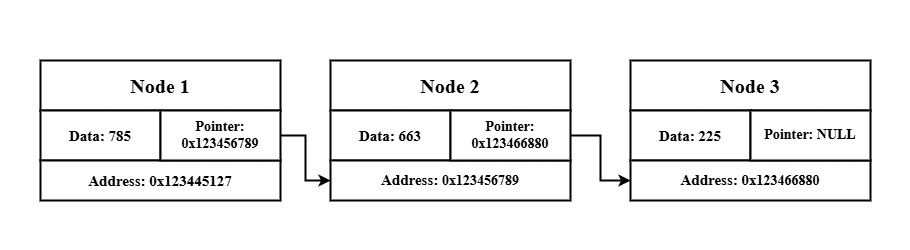
A Linked List is a common data structure, composed mainly of data and the address of the next node, forming a structure where nodes link to each other, with the last node pointing to the NULL address.

The main way we implement it is with C. To implement a Linked List, we must first define the node itself with a struct.

Implementing a Linked List

Defining the node

1
2
3
4
typedef struct node{
int data;
struct node *next;
} Node;

Above we define the node struct, which contains integer data data, representing the data the node holds, and a struct-type pointer next, the memory address of the next node of the same struct. This struct is declared as Node for convenience in declaring nodes later.

1
2
3
Node *first_node;
Node *current_node;
Node *previous_node;

We can use Node to declare three pointers pointing to the memory addresses of three structs: first_node, current_node, previous_node. The uses of these three pointers:

  • first_node points to the starting address of the chain
  • current_node points to the current node in the chain, often used when traversing the list
  • previous_node points to the node before current_node, often used when creating nodes or reversing the whole linked list

Now we can start building the chain from scratch.

Building the Linked List

1
2
3
4
5
6
7
8
9
10
11
12
13
14

int main(){
int node_numbers;
scanf("%d",&node_numbers);
create_new_node(node_numbers);
current_node = first_node;
while (current_node!= NULL){
printf("[%p]|",current_node);
printf("Data: %d",current_node->data);
printf("| Addr. of next node=%p \n",current_node->next);
current_node=current_node->next;
}
return 0;
}

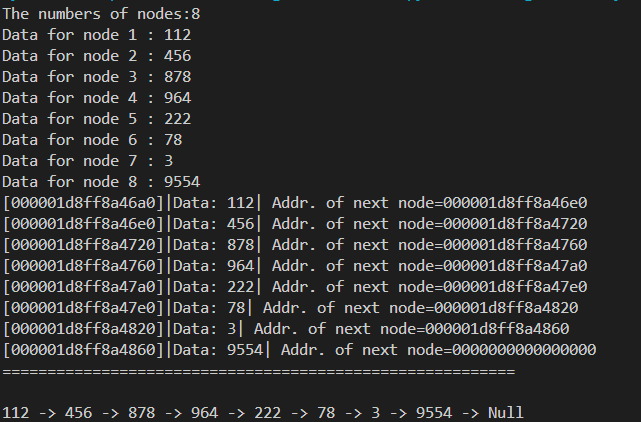
In the code above, we first provide input to decide the number of nodes to create, then call the create_new_node function, and print each node’s data and the next node’s address in order from the first node, finally moving to the next node via current_node=current_node->next;.

The main thing to do here is build the create_new_node function.

Creating nodes (create_new_node)

1
2
3
4
5
6
7
8
9
10
11
12
13
14
15
16
17
18
19
20
21
22
23
void create_new_node(int node_nums){
int i;
for (i=0; i< node_nums; i++){
// Declare new node
current_node = (Node*)malloc(sizeof(Node));
printf("Data for node %d : ",i+1);
// Enter node data
scanf("%d", &(current_node->data));

// First node, don't have previous node, so let the first_node and previous_node equal to current_node
if(i==0){
first_node = current_node;
previous_node = current_node;
}
else{
// Set the previous node point to the current node
previous_node->next = current_node;
current_node->next = NULL;
// Set the previous node to current node, prepare to next node creation (or not)
previous_node = current_node;
}
}
}
  • Inside the function, a for loop repeats the node creation
  • Dynamically allocate space of Node size with malloc, and point current_node at its memory address
  • Let the user manually enter the data content
  • current_node -> data means accessing the data variable at this memory address; here we directly store the manually entered data value into the node’s data variable
  • Then judge whether we’re creating the first node. When creating the first node, remember to update the first_node pointer to point to the current node, and since there’s no previous node at this point, also update previous_node to current_node, i.e. the current node
  • When creating subsequent nodes, make the previous node point to the current node’s memory address so they link up, so previous_node->next = current_node;
  • And point current_node‘s next node memory address to NULL, so current_node -> next = NULL;
  • Finally, update previous_node to the current node

Printing the list (PrintList)

After building the nodes, you inevitably want to print the whole list

1
2
3
4
5
6
7
8
9
10
11
12
13
14
15
// input parameter is node struct
void PrintList(Node* first){
// Decalre the address of input node
Node *node = first;
if (first == NULL){
printf("List is empty!\n");
}
else{
while( node != NULL){
printf("%d -> ", node->data);
node = node->next;
}
printf ("Null \n");
}
}
  • The main logic is to run from the first node along the chain, so node = node -> next until hitting Null
  • The function’s input is the initial node address
  • Need to judge whether the list is empty

Then call it in the main function to print

1
PrintList(first_node);

Freeing memory

Since every node is dynamically declared with malloc, the memory addresses occupied must be freed after execution ends, so we likewise need to iterate over each chain node and free() it

1
2
3
4
5
6
7
8
9
10
11
12
void FreeList(Node* first){
Node *current, *temp_node;
current = first;
while ( current != NULL ){
// Put the node that wants to be removed into temp_node
temp_node = current;
// Let the current node point to the next node
current = current->next;
// Free the node
free(temp_node);
}
}
  • The function’s input parameter is likewise the initial node’s address
  • Before reaching NULL, we need to put the current node into a temporary memory address to free() it; if we directly free(current), the next node’s memory address stored in it can’t be found
  • Then let the current node keep going down the list current = current->next;

Searching for a node

1
2
3
4
5
6
7
8
9
10
11
12
// Return value should be the address of the node
Node* SearchNode(Node* first, int item){
Node * node = first;
while ( node != NULL){
if (node->data == item){
return node;
}
else{
node = node->next;
}
}
}
  • The function’s declared type is also Node* because the return value is a struct pointer, i.e. a node’s memory address
  • The input parameters also need the list’s initial node address and the data value to find
  • Likewise go down the list (node= node->next;); if a node’s data value equals item is found, return the node, until hitting Null

Inserting a node

Inserting a node is split into different functions for different situations:

  • Insert into the middle of the list
  • Insert at the head of the list
  • Insert at the tail of the list

Insert in the middle

1
2
3
4
5
6
7
8
9
void InsertNode(Node* node, int item){
Node *new_node;
new_node = (Node*)malloc(sizeof(Node));
// Point the new node to the nexy item of original node
new_node->data = item;
new_node->next = node->next;
// Point the original node to new node
node -> next = new_node;
}
  • The function’s input parameter is a node, and you also need to provide the inserted node’s data value
  • Then create a new node and allocate memory for it
  • Put the data value item into the new node’s data variable
  • Put the original input node’s next node address into the new node’s next
  • Point the original input node’s next at the new node we created
    This completes the node insertion.

Insert at the head

1
2
3
4
5
6
7
8
// Insert a node to the front of the list
void push_front(int item){
Node * new_node;
new_node = (Node*)malloc(sizeof(Node));
new_node->data = item;
new_node->next = first_node; // new node pointer point to original first node
first_node = new_node; // Update the first node to the new node
}
  • Since it’s the head, the input parameter is just the data value
  • Likewise create a new node and allocate memory for it
  • Put item into the new node’s data
  • Point the new node’s next at the first node
  • Update first_node to the new node

Insert at the tail

1
2
3
4
5
6
7
8
9
10
11
12
13
14
15
16
17
18
19
20
21
// Insert a node to the back of the list
void push_back(int item){
Node * new_node;
new_node = (Node*)malloc(sizeof(Node));
new_node->data = item;
new_node->next = NULL;
// Handle empty list
if (first_node == NULL){
first_node = new_node;
}
else{
// Initailize the current node to the first node for traversal
Node * current_node = first_node;
while (current_node->next != NULL){
// traverse through the list
current_node = current_node->next;
}
// Point to the new node
current_node->next = new_node;
}
}
  • Likewise the input parameter is the new node’s data value
  • Likewise create a new node and allocate memory for it
  • Give the new node’s data value item
  • Point the new node’s pointer at NULL
  • Next is handling the insertion, but first there’s an exception case: judge whether the list is empty; if empty, update first_node to our newly created new_node
  • If the list isn’t empty, first traverse the whole list to find the last node, so update current_node to first_node
  • If the last node hasn’t been reached, keep traversing current_node = current_node->next;
  • After reaching the last node, point the last node’s pointer at the newly created node

Deleting a node

1
2
3
4
5
6
7
8
9
10
11
12
13
14
15
16
17
18
19
20
21
22
23
24
Node* DeleteNode(Node* first ,Node* node){
Node* ptr= first;
if (first == NULL)
{
printf("Noting to print\n");
}
// Delete first node of the list
if (node == first){
// Update the first pointer to the next node
first = first->next;
free(node);
return first;
}
else{
// ptr traverse through the list
while (ptr->next != node)
{
ptr = ptr->next;
}
ptr->next = node->next;
free(node);
return first;
}
}
  • The input parameters are the initial node and the node to be deleted
  • At the start we likewise need to judge whether first_node is null; if null there’s nothing to delete
  • Then split into different cases:
    • Delete the head
    • Delete the middle and tail
  • To delete the head, first update first_node to its next node
  • Then directly use free() to release the memory
  • Otherwise, while the chain hasn’t reached the node to be deleted, keep traversing (ptr = ptr->next)
  • Once found, point its pointer at the next node’s next node address
  • Then directly use free() to release the memory

Reversing the Linked List (Reverse Linked List)
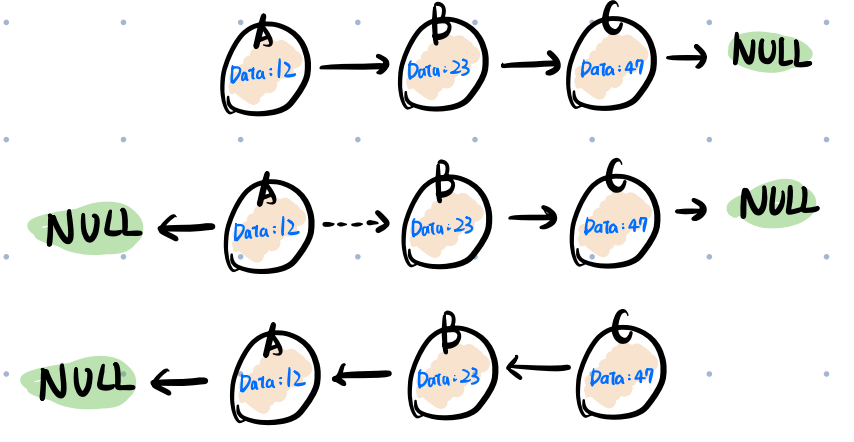
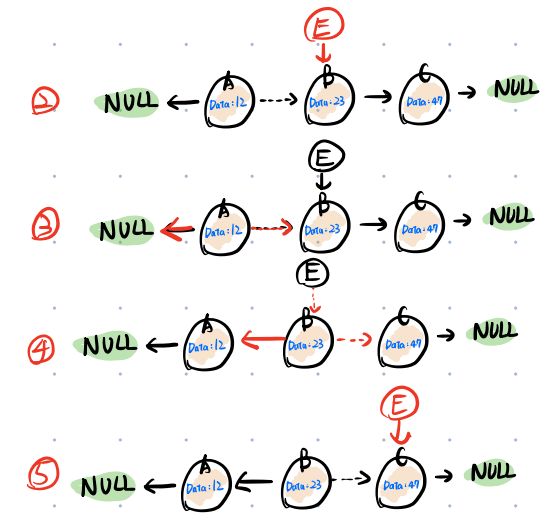
To reverse a list, you need an extra node to temporarily hold a node’s address.

Explanation

If you first point the initial node (node A)’s pointer at NULL, there’s a problem: the original pointer stored the next node’s address. If you change it to NULL, don’t you then not know the original next node’s address? Without even the node’s address, how do you reverse? So you need an extra node pointing to node B to hold B’s memory address.

So the steps are as shown below:

  1. Define a pointer pointing to NULL
  2. Create a temporary node pointing to the current node’s next node
  3. Change the current node to point to NULL
  4. Change the next node (node B) to point to the previous node (node A)
  5. Update the temporary node’s pointer to point to the next node’s address
1
2
3
4
5
6
7
8
9
10
11
12
13
14
15
16
17
18
19
void Reverse(){  
Node *current, *previous, *preceding;
previous = NULL;
current = first_node;
// preceding node store the previous address of the current node
preceding = first_node->next;
while (preceding != NULL){
// pointer the current node to the NULL (previous) node
current->next = previous;
// Update previous poinert to current pointer
previous = current;
// Update current pointer to the preceding point
current = preceding;
// Update the preceding pointer to the next node;
preceding = preceding->next;
}
current->next =previous;
first_node=current;
}
  • current: the pointer to the current node, initialized to the linked list’s first node first_node
  • previous: the pointer to the previous node, initialized to NULL, since there’s no previous node at the start
  • preceding: the pointer to the current node’s next node, initialized to first_node‘s next node
  • Then in the while loop, loop through the linked list until preceding becomes NULL
  • current->next = previous;: point the current node’s next pointer at the previous node (reversing the pointer direction)
  • previous = current;: update previous to the current node
  • current = preceding;: update current to the next node
  • preceding = preceding->next;: update preceding to the next node’s next node
  • Then handle the last node, likewise pointing the last node’s next pointer at the previous node (reversing the pointer direction)
  • Also update the initial node’s pointer to the current node
  • first_node = current;: update the linked list’s head node first_node; now current points to the original linked list’s last node, i.e. the new head node

Full code

1
2
3
4
5
6
7
8
9
10
11
12
13
14
15
16
17
18
19
20
21
22
23
24
25
26
27
28
29
30
31
32
33
34
35
36
37
38
39
40
41
42
43
44
45
46
47
48
49
50
51
52
53
54
55
56
57
58
59
60
61
62
63
64
65
66
67
68
69
70
71
72
73
74
75
76
77
78
79
80
81
82
83
84
85
86
87
88
89
90
91
92
93
94
95
96
97
98
99
100
101
102
103
104
105
106
107
108
109
110
111
112
113
114
115
116
117
118
119
120
121
122
123
124
125
126
127
128
129
130
131
132
133
134
135
136
137
138
139
140
141
142
143
144
145
146
147
148
149
150
151
152
153
154
155
156
157
158
159
160
161
162
163
164
165
166
167
168
169
170
171
172
173
174
175
176
177
178
179
180
181
182
183
184
185
186
187
188
189
190
191
192
193
194
195
196
197
198
199
200
201
202
203
204
205
206
207
208
209
210
211
212
213
214
215
216
217
218
219
220
221
222
223
224
225
226
227
#include <stdio.h>
#include <stdlib.h>

// define node
typedef struct node
{
int data;
struct node *next;
}Node;

Node *first_node;
Node *current_node;
Node *previous_node;

// Declare Fuctions

void create_new_node(int node_nums);
void PrintList(Node* first);
void FreeList(Node* first);
Node* SearchNode(Node* first, int item);
void InsertNode(Node* node, int item);
void push_front(int item);
void push_back(int item);
Node* DeleteNode( Node* first,Node* node);
void Reverse();

int main(){

int node_numbers;
int item;
printf("The numbers of nodes:");
scanf("%d",&node_numbers);
create_new_node(node_numbers);
current_node = first_node;
while (current_node!= NULL){
printf("[%p]|",current_node);
printf("Data: %d",current_node->data);
printf("| Addr. of next node=%p \n",current_node->next);
current_node=current_node->next;
}

// Traverse the list of nodes
printf("=========================================================\n\n");
PrintList(first_node);
printf("Serach Nodes: ");
scanf("%d",&item);
if (SearchNode(first_node,item)){ printf("Node found\n");} else {printf("Node not found\n");}


printf("Insert Node:");
// User input data
scanf("%d",&item);
if (SearchNode(first_node,item)){
printf("Node exisit in the list");
}
else {
// Insert behind the current node
InsertNode(first_node,item);
PrintList(first_node);
}

printf("Reverse the list\n");
Reverse();
PrintList(first_node);

FreeList(first_node);

system("pause");
return 0;
}

void create_new_node(int node_nums){
int i;
for (i=0; i< node_nums; i++){
// Declare new node
current_node = (Node*)malloc(sizeof(Node));
printf("Data for node %d : ",i+1);
// Enter node data
scanf("%d", &(current_node->data));

// First node, don't have previous node, so let the first_node and previous_node equal to current_node
if(i==0){
first_node = current_node;
previous_node = current_node;
}
else{
// Set the previous node point to the current node
previous_node->next = current_node;
current_node->next = NULL;
// Set the previous node to current node, prepare to next node creation (or not)
previous_node = current_node;
}
}
}

// input parameter is node struct
void PrintList(Node* first){
// Decalre the address of input node
Node *node = first;
if (first == NULL){
printf("List is empty!\n");
}
else{
while( node != NULL){
printf("%d -> ", node->data);
node = node->next;
}
printf ("Null \n");
}
}

void FreeList(Node* first){
Node *current, *temp_node;
current = first;
while ( current != NULL ){
// Put the node that wants to be removed into temp_node
temp_node = current;
// Let the current node point to the next node
current = current->next;
// Free the node
free(temp_node);
}
}

// Return value should be the address of the node
Node* SearchNode(Node* first, int item){
Node * node = first;
while ( node != NULL){

if (node->data == item){
return node;
}
else{
node = node->next;
}
}
}

void InsertNode(Node* node, int item){
Node *new_node;
new_node = (Node*)malloc(sizeof(Node));
// Point the new node to the nexy item of original node
new_node->data = item;
new_node->next = node->next;
// Point the original node to new node
node -> next = new_node;
}

// Insert a node to the front of the list
void push_front(int item){
Node * new_node;
new_node = (Node*)malloc(sizeof(Node));
new_node->data = item;
new_node->next = first_node; // new node pointer point to original first node
first_node = new_node; // Update the first node to the new node
}

// Insert a node to the back of the list
void push_back(int item){
Node * new_node;
new_node = (Node*)malloc(sizeof(Node));
new_node->data = item;
new_node->next = NULL;
// Handle empty list
if (first_node == NULL){
first_node = new_node;
}
else{
// Initailize the current node to the first node for traversal
Node * current_node = first_node;
while (current_node->next != NULL){
// traverse through the list
current_node = current_node->next;
}
// Point to the new node
current_node->next = new_node;
}
}

Node* DeleteNode(Node* first ,Node* node){
Node* ptr= first;
if (first == NULL)
{
printf("Noting to print\n");
}
// Delete first node of the list
if (node == first){
// Update the first pointer to the next node
first = first->next;
free(node);
return first;
}
else{
// ptr traverse through the list
while (ptr->next != node)
{
ptr = ptr->next;
}
ptr->next = node->next;
free(node);
return first;

}
}

void Reverse(){


Node *current, *previous, *preceding;
previous = NULL;
current = first_node;
// preceding node store the previous address of the current node
preceding = first_node->next;

while (preceding != NULL){
// pointer the current node to the NULL (previous) node
current->next = previous;
// Update previous poinert to current pointer
previous = current;
// Update current pointer to the preceding point
current = preceding;
// Update the preceding pointer to the next node;
preceding = preceding->next;
}
current->next =previous;
first_node=current;
}

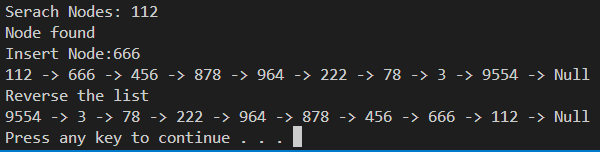
Execution result


Summary: through this writeup, I got more familiar again with the linked-list operations I’d forgotten. Next I’ll just grab related LeetCode problems for practice.

References

[1] https://jacychu.medium.com/leetcode-linked-list-%E9%8F%88%E7%B5%90%E4%B8%B2%E5%88%97-c2edabee9958
[2] https://codimd.mcl.math.ncu.edu.tw/s/B1rd5-sM4#%E6%8F%92%E5%85%A5%E7%AF%80%E9%BB%9E%E5%87%BD%E6%95%B8-InsertNode-