
Must-Know Problem-Solving Knowledge | Stack | LeetCode Notes
🌐 中文版:繁體中文
What is a Stack?
A Stack is a data structure with the Last-In-First-Out (LIFO) property.
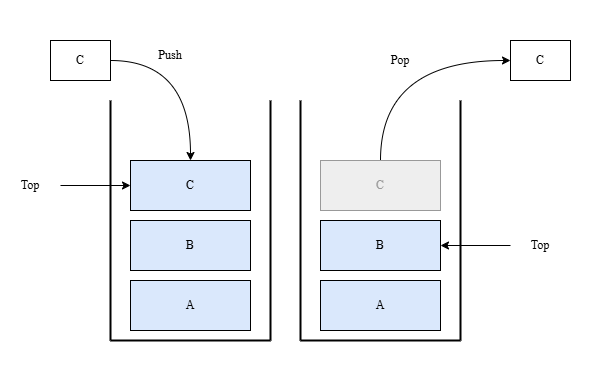
Stack implementation (C++)
Here I want to implement a complete Stack in C++, realizing the common operations like push, pop, isEmpty, and so on.
Implementing a Stack with an Array
When implementing a Stack in C++, note that some variables shouldn’t be accessible from outside, like
top: used to point to the top of the stack, i.e. the topmost indexcapacity: the stack’s memory size*stack: a pointer to the stack
So the variables related to the above need to be private member variables. Also, when implementing a Stack with an array, you sometimes run out of memory, so you can solve this by creating a function that automatically expands the capacity.
Also, when implementing Pop, you don’t actually need to remove the data; instead you subtract 1 from top, as if we really deleted the data from the stack, but we actually didn’t, and we just overwrite the existing data on a future Push. This approach saves memory-operation cost.
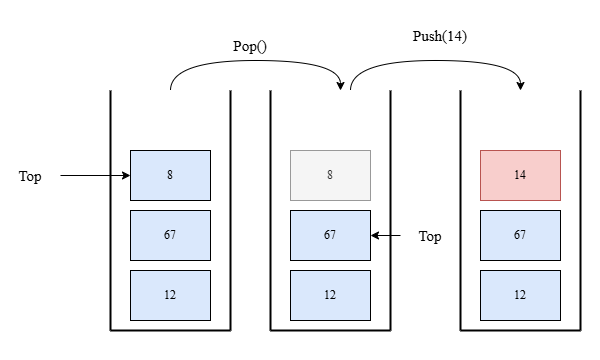
Note: before a Pop or a Top operation (returning the current topmost data value of the stack), you need to first check whether the stack is empty,
st.empty()
Full code
1 |
|
Output:
1 | Empty Stack, nothing to pop! |
Code explanation
1 | class StackArray{ |
We define the Stack itself and the corresponding operations by creating a StackArray class. For initialization, we use the constructor StackArray (the constructor has the same name as the class) to initialize the private member variables top=-1, capacity=1, and declare a new memory space, an integer array of size capacity, with the pointer stack* pointing to it.
Then in the public section we declare the various operations we’ll later perform on the Stack.
1 | void StackArray::DoubleCapacity() { |
The DoubleCapacity function mainly multiplies capacity by 2, then defines a new stack with double the capacity, copies all the old stack’s data over, then frees the old stack’s array memory and updates the pointer.
1 | void StackArray::Push(int x) { |
For Push, first make sure the Stack is full or not. The way to check is whether top‘s value equals capacity-1 (subtract 1 because it’s an array); if equal, it’s full and needs more space, so just call the DoubleCapacity function we defined earlier. Then push data into the Stack. Here, to reduce line count, ++top and stack[top] =x are merged into one line.
For Pop, you first need to check whether the Stack is empty, so call the isEmpty() function to confirm. If empty, print a message and return to the main function; if not empty, just decrement the top value by 1.
1 | bool StackArray::isEmpty(){ |
- For
isEmpty(), compare whether top is the initial value; if so it’s empty, if not it’s not empty. - For
Top(), likewise first check whether the stack is empty; if empty return to main func, if not empty return the content value at the top of the stack getSize(): just return top+1 (because of array index arithmetic, it’s declared as -1 at first, so you add it back)
Implementing a Stack with a Linked List
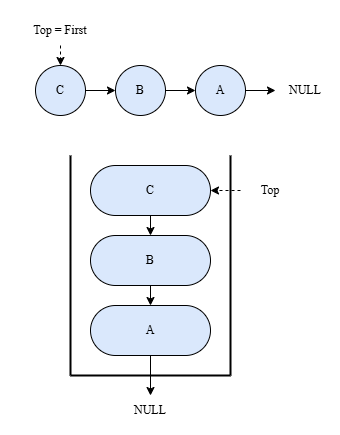
If you implement a Stack with a Linked List, the first or head in the Linked List, i.e. the first element of the chain, is the top of the Stack, so pushing onto the Stack is equivalent to using the push_front() function in the Linked List.
The code below mainly implements it with two classes, StackNode and StackList. StackNode defines the Linked List’s node, while StackList defines the head node, i.e. *top.
What’s the difference between defining a node with a struct vs a class?
Member variables defined with a struct are always public, accessible by anyone, but with a class you can put the stack’s entry
topin private, which restricts access to the node, so main() can’t change each node’s data. This could be a security consideration.
Full code
1 |
|
Output
1 | Empty stack, nothing to pop out! |
Code explanation
1 | class StackList; |
StackNode part:
- First, declare
class StackListat the beginning, because inclass StackNodewe’ll makeStackLista friend class - Then define
class StackNode. Here three constructors are defined, corresponding to three cases:- No argument given: initialize the node’s data and pointer to 0, meaning a single node with data 0
- Given argument x: initialize the node’s data to x and next to 0, meaning a single node with data x
- Given argument x and the next node’s address
next: meaning a node is added to a non-empty stack
- Then make
StackLista friend class ofStackNode
StackList part:
- First declare the private members
*top,size, representing the stack’s top node and the stack’s size - Then the public members. First, likewise use the constructor to initialize
size=0,top=0 (nullptr) - Define functions like
Push(int x),Pop(),IsEmpty(),Top(),getSize()
1 | void StackList::Push(int x){ |
- For the Push function, first likewise confirm whether it’s an empty stack, because this affects which constructor we use. If empty, create a new node
new StackNode(x), i.e. a new node withdata=x, and pointtopat that node; at this point the stack size needs +1, then return to the main function. If the stack isn’t empty, we need to realize push_front, so again add a new node. There are two ways to write this: the one above defines the node via the second constructor, manually points it at the original top node, then updates the top pointer. This can also be rewritten asstackNode *newNode = new StackNode(x, top), then just update the top pointer.
1 | void StackList::Pop(){ |
- For the Pop function, likewise first confirm whether it’s empty; if the stack is empty, return to main()
- If not empty, follow the same steps as deleting a node in a regular Linked List: define a temporary node, temporarily keep the top node, then update top to the next node, then delete the temporary node’s data
- The most important step is to set the temporary node to 0, i.e.
nullptr(becausenextis set to 0), to prevent a dangling pointer, since the pointer variable still exists. - Remember stack size needs -1
1 | bool StackList::isEmpty(){ |
isEmptyjust checks thesizevalueTop()likewise first checks whether it’s an empty stack; if not, just return the top node’s data valuegetSize()returnssize
Stack-related STL
You need to include the stack template library
1 |
|
The <int> inside the angle brackets means this stack holds integers.
If you want to hold other types of data in the stack,
you can also declare it like this
1 | stack<float> sk; |
Using the STL you don’t need to implement push() and pop() yourself
1 |
|
1 | int a = sk.pop(); // -78 |
1 | sk.top(); //666, since -78 is poped from stack |
1 | sk.empty(); //return true or false |
Time complexity of Stack operations
According to the summary in [5], the average time complexities of regular stack operations are:
- Access: $O(N)$
- Search: $O(N)$
- Insertion: $O(1)$
- Deletion: $O(1)$
$N$ is the number of data items in the stack
Classic Stack LeetCode problems
Easy
- 20. Valid Parentheses
- 1614. Maximum Nesting Depth of the Parentheses
- 232. Implement Queue using Stacks
Medium
Hard
Reference
[1] https://hackmd.io/@meyr543/SksrPAEIt
[2] https://hackmd.io/@Greenleaf/advanced_cpp#%F0%9F%8E%A0-stack-%E5%A0%86%E7%96%8A
[3] https://alrightchiu.github.io/SecondRound/stack-yi-arrayyu-linked-listshi-zuo.html
[4] https://hackmd.io/@CLKO/BkZaF56Cm?type=view
[5] https://www.bigocheatsheet.com/






If you find my articles helpful, please support Kevin!
 Use boba to safe Kevin!