The One Line That Got Rewritten | Channel Hop | GaianSpace CTF 2026
🌐 中文版:繁體中文
This is the opening post of my favourite storyline in GaianSpace CTF 2026. The whole series is built around one idea: you hand-build a LoRa demodulator yourself, and then keep growing it: from a single fixed parameter set, to implicit headers, to Doppler drift, and finally to frequency hopping.
This first post doesn’t touch IQ yet; it’s a warm-up at the packet layer. The real IQ work starts in the next post, True Color Is a Lie.
Rest of the series: Isodata Seven、Subsidy Claim、Two Voices、No Name on the Door、Hopscotch
What the challenge is about
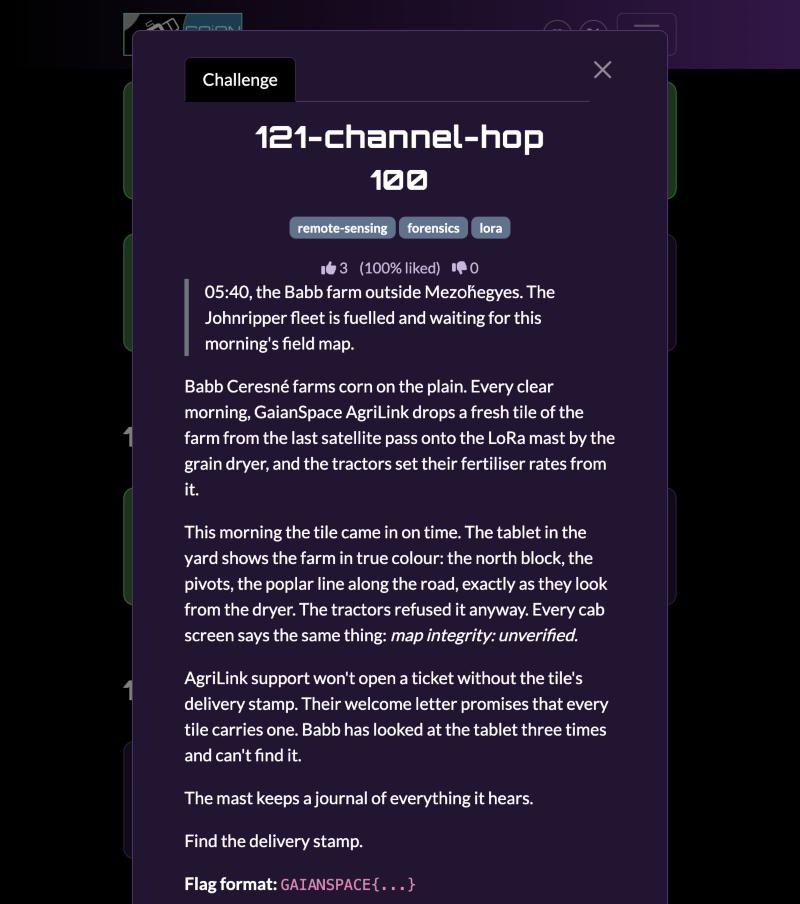
Every morning, Babb’s corn farm receives a GaianSpace AgriLink satellite tile through a LoRa mast. This particular morning the tractor shows map integrity: unverified and refuses to use the tile. Support won’t open a ticket without the tile’s delivery stamp, but the farmer can’t find it anywhere on the tablet. Luckily, the mast kept a log of what it received.
Goal: find the delivery stamp.
The files given are mast_rx_0540.log (the receive log, 641 lines of hex packets) and agrilink_welcome.txt (the sign-up welcome letter, “some of it may be out of date”).
Flag format: GAIANSPACE{...}
Read the log, rebuild the tile
The first packet in the log decodes to a chunk of text metadata:
1 | tile=0704 site=BABB-N date=2025-07-04 src=S2 L2A gsd=10m px=128x128 ch=B02,B03,B04,B08,B11 scale=refl*400 |
That one line tells us everything:
- The data comes from Sentinel-2, 128×128 pixels, 10 m resolution.
- And there are 5 channels:
- B02 (blue)
- B03 (green)
- B04 (red)
- B08 (near-infrared)
- B11 (short-wave infrared)
- But the welcome letter only mentions 4 channels (blue/green/red + NIR). It quietly left one out.
The remaining packets follow the format AL 02 04 07 'D' <channel 0–4> <row 0–127> <128 pixel bytes>.
5 channels × 128 rows = 640 data packets, plus one trailing packet. Drop them back into five 128×128 grayscale images and the whole tile comes back.
Compose blue/green/red (B04/B03/B02) into a true-colour image and you get exactly what the farmer sees on the tablet: circular pivot-irrigation fields, roads, solar panels. Everything looks normal, and there’s no stamp in sight:
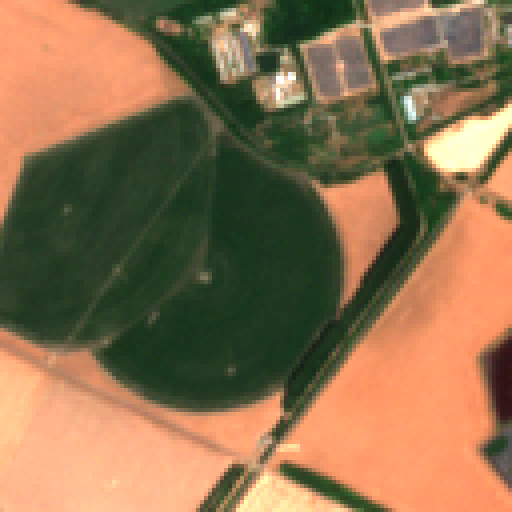
The stamp is hiding in a channel the tablet never shows
The tablet only builds true colour from blue/green/red, so if the stamp lives in another channel, the farmer will never see it. I ran a high-pass filter on each channel (subtract a Gaussian blur, then boost the contrast) to amplify the tiny brightness variations:
1 | hp = a - gaussian_filter(a, 1.5) |
Line the five high-pass images up side by side and the answer jumps right out.
Only B08 (near-infrared) has three lines of text written across the fields:
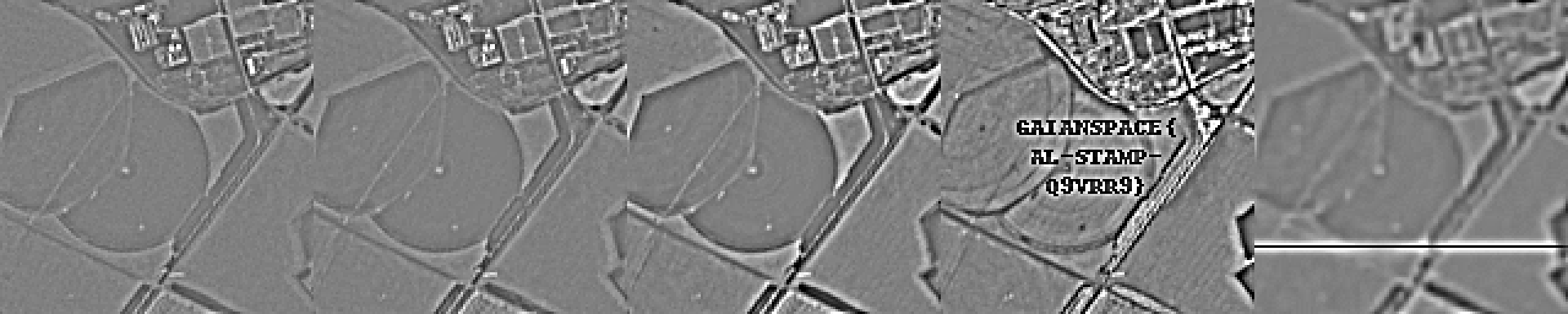
The brightness difference in the raw image is tiny and completely invisible to the eye, and the true-colour composite doesn’t use B08 at all. That’s the whole trick: the stamp was written into a channel the tablet simply never renders.
Flag
1 | GAIANSPACE{AL-STAMP-Q9VRR9} |
Takeaways
- When something is “invisible,” first list what data isn’t being displayed. The way in here: the metadata lists 5 channels, the welcome letter claims 4, and the tablet only uses 3. The stamp is hiding in the channel everyone ignores.
- For image stego, a per-channel high-pass or contrast stretch makes hidden watermarks pop. Especially with multispectral satellite imagery, where different bands carry wildly different amounts of information, so don’t just stare at the visible light.
- Don’t rush to chase the noise in the log (dropped packets, RSSI, SNR). I spent a while hunting missing packets and looking for patterns in RSSI, and they were all red herrings. Reconstruct the actual data and look at it first; that beats drilling into details.
- The challenge name
channel-hopmeans “search across different channels (bands),” not LoRa frequency hopping. Real hopping doesn’t show up until the final post in the series, Hopscotch.
If you find my articles helpful, please support Kevin!
 Use boba to safe Kevin!