
A Logic Gate Shorted by Radiation | Ionized Transistangle | GaianSpace CTF 2026
Third post of the GaianSpace CTF 2026 “05-rad-hard-rampage” series.
🌐 中文版:繁體中文
The first two posts (SEU, SEL) were both single-event effects: one particle, one bit, one instant. This one is a cumulative effect: not a single hit, but months of radiation dose slowly wrecking the transistors. The failure model shifts from “data got changed” to “the logic itself is broken,” so the approach is completely different.
Other post in the series: Sensor Drift / Degradift
What the challenge is about
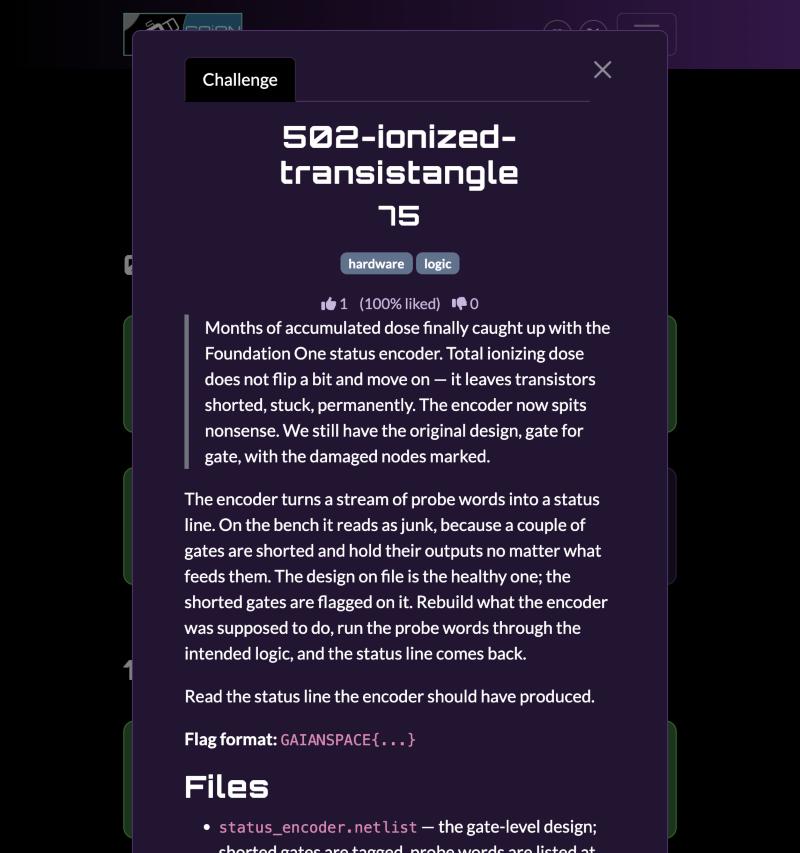
Total ionizing dose does not flip a bit and move on — it leaves transistors shorted, stuck, permanently. The encoder now spits nonsense. We still have the original design, gate for gate, with the damaged nodes marked.
In plain terms: months of accumulated radiation dose have finally taken out Foundation One’s status encoder. Total Ionizing Dose (TID) doesn’t flip one bit and move on. It shorts transistors permanently and jams them. The encoder now spits out garbage. We still have the original design, gate for gate, with the damaged nodes marked.
The encoder turns a string of probe words into a line of status words, but what’s measured on the board is garbage, because a few gates have shorted: no matter the input, their outputs are jammed.
In other words, we need to reconstruct what the encoder was supposed to do: run the probe words through the “as-designed” logic, and the status line comes back.
The file given is a gate-level netlist status_encoder.netlist, with the shorted gates marked and the probe words listed at the end.
Flag format:
GAIANSPACE{...}.
Reading the netlist
1 | INPUTS i0 i1 i2 i3 i4 i5 i6 i7 |
8 inputs, 8 outputs, all XOR chains plus some NOTs. Two nodes, n6 and n15, are marked [SHORTED=0] and [SHORTED=1].
This is the challenge’s “transistors shorted, outputs permanently jammed at some value no matter the input.”
The short value is a lie, so use the design value
This is the twist of the whole challenge, matching the hint “A short is a lie.”
Total Ionizing Dose (TID) is a completely different radiation effect: not the instant event of one particle, but long-term accumulated charge trapped in the oxide layer, slowly drifting the transistors’ threshold voltage and leaking, until some gates “stick” at a fixed output and never respond to input again.
So what’s measured on the board now is the two post-damage jammed values, which are the result of the fault, not the design intent. [SHORTED=0]/[SHORTED=1] are just recording what it’s broken into now, so when reconstructing you must completely ignore those markers and compute n6, n15 by their original logic (n6 = i0 XOR i1, n15 = i1 XOR i3), no different from any other healthy gate.
Feed the probe words through the “as-designed” logic
The netlist comments spell out that each probe byte’s bits map to i7..i0 (bit 0 → i0, bit 7 → i7).
Feed the 32 probes in order through the as-designed logic (ignoring the short markers), compute each group’s o0..o7, and reassemble into a byte.
To see the damage’s effect clearly at the same time, I simulated both “run as damaged” and “run as designed”:
1 | def run(byte, damaged): |
Put the two outputs side by side and the conclusion is obvious:
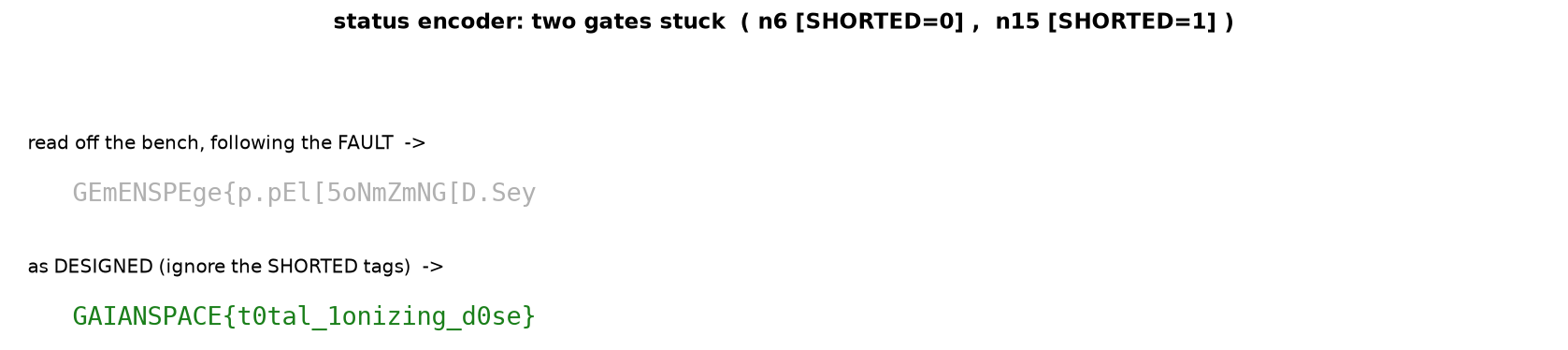
Interestingly, the damaged output’s first few characters still coincidentally show hints of GE and ENSPE (probably because some output bits happened not to be affected by those two jammed gates), but overall it’s not text at all. Only running fully as-designed (both gates treated as normal XOR) makes the 32 probes map to the complete, clean flag.
Flag
1 | GAIANSPACE{t0tal_1onizing_d0se} |
Takeaways
- “Stuck” and “flipped” are two completely different failure models. A flip (SEU) changes just one value, so you enumerate to recover it (see the first post); a stuck gate (TID) returns the same value for all inputs and propagates downstream. The solution isn’t to guess “what the correct value is,” but to directly reconstruct the as-designed logic.
- When the challenge explicitly says a marker is “the broken state,” don’t let it lead you around. The
[SHORTED=...]value describes the fault; it’s not meant to be used, so treat it as noise to ignore. The real work here is “correctly turning the netlist into a simulator”; the logic itself is simple. - Building both “run as damaged” and “run as designed” for comparison does more than verify understanding; it’s also vivid. You see at a glance how far the short corrupts the downstream signal, and it confirms your simulator isn’t buggy.




If you find my articles helpful, please support Kevin!
 Use boba to safe Kevin!